Raiders of the Gold Art: the Louvre Museum Heist
The theft of priceless historical jewels from the largest museum in the world confirms the endangered status of cultural heritage in gold and precious stones

Background
In the morning of Sunday 19 October 2025, robbers disguised as construction workers broke into the Musée du Louvre, Paris, undetected. They entered the building at about 9.30 a.m., in broad daylight, when the museum had already opened its doors to visitors. Wearing yellow safety vests, the thieves reached the “Galerie d’Apollon” – a magnificently decorated wing housing the French Crown Jewels and the royal collection of hardstone vessels – through a furniture hoist. The hoist was mounted on a small lorry parked on a public road next to the façade of the Gallery that overlooks the River Sein and was later found with the extendable ladder stretched out to its first-floor balcony. After forcing the French window, the thieves entered the exhibition space, cut two of the high-security display cases open with the use of a disc cutter, raided their content, and left, escaping on scooters, all in a handful of minutes. Upon discovery of the theft, the Louvre was immediately evacuated and closed to the public. No one was injured during the incident, except the Museum reputation.

The heist was a cakewalk. France’s Culture Minister Rachida Dati told news outlet TF1 that footage of the theft shows the robbers entering the building “calmly”. She described the thieves as “experienced” and the heist as a “professional 4-minute operation”. Security guards appear to have entered the Apollo Gallery only after alarms went off, a detail indicating – if confirmed – that the space was unmanned. According to British newspaper The Guardian, Louvre agents entered the room only when the intruders had already left. The same source states that “officials said the thieves were inside the Apollo gallery for only four minutes and the whole robbery was over in seven minutes”. At the time of writing, it is unclear whether visitors were present in the room and did not question or stop the thieves because deceived by their yellow vests.
Overall, the dynamics of the theft raise doubts about the security measures in place, in particular the quality of the display cases containing the French Crown Jewels, the fact that the windows were not secured and the lack of a rapid-response unit. A state auditor report covering a period of five years between 2019 and 2024 obtained by France Inter and due to be published next month criticises “considerable” and “ persistent” delays in updating the museum security apparatus. According to the report, the Louvre lacked security cameras in one third of its rooms.
Insufficient staff also appears to be an issue. In June this year, strikes against mass tourism and overcrowding forced the museum to close for a brief period of time. Overcrowding had been addressed in 2023 by reducing the maximum number of daily visitors to 30,000 – a third of their previous limit – but the measure proved insufficient as staff remained under intense pressure, apparently unable to exert appropriate control on the museum countless artworks, visitors, entrances and exits. Physical surveillance seems to have been affected over the past 15 years by cuts of 10% (200 full-time posts) out of a total workforce of about 2,000.
In response to security concerns, in January this year President Emmanuel Macron had announced a colossal renovation project featuring a “security master plan”. Clearly, the decision arrived too late. “The responsibility lies with 40 years of abandonment during which problems were swept under the rug … We always focused on the security of cultural institutions for visitors, much less for that of the artworks” Culture Minister Dati told broadcaster M6 the day after the heist.
The President and Director of the Louvre, Laurence des Cars, was booed in an address to museum staff following the incident. She offered her own resignation to Dati on Sunday but the Minister of Culture refused. Des Cars spoke publicly about the theft of the Crown Jewels for the first time when questioned in the French senate three days later. During the two-hour hearing, held on Wednesday 22 October, des Cars declared that the only camera installed outside the Apollo Gallery did not cover the balcony through which the burglars broke in as it (the camera) was facing the wrong way; she added that there are few perimeter cameras in place at the museum and that they are inadequate and outdated. The Director of the Louvre confirmed that the museum failed to detect the thieves early enough to be able to stop them and that Police was called only five minutes after they arrived; she requested the Ministry of the Interior to assess the feasibility of a police station within the building in order to guarantee a police presence. According to the BBC, some of the detail emerged during the hearing was simply astounding and several senators expressed incredulity at the state of the Louvre security and the “jaw-dropping revelations”.

According to France’s Ministry of Culture, eight Crown Jewels, all dating back to the Napoleonic period, were stolen in the heist:
– a tiara from the sapphire jewellery set of Queen Marie-Amélie and Queen Hortense, featuring 24 Ceylon sapphires and 1,083 diamonds;
– a necklace from the sapphire jewellery set of Queen Marie-Amélie and Queen Hortense;
– an earring, part of a pair from the sapphire jewellery set of Queen Marie-Amélie and Queen Hortense. The set, the precise origins of which are unknown, entered the Louvre collection in 1985, when it was acquired from the Orleans family.
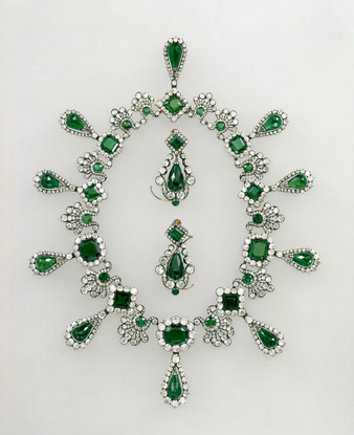
– an emerald necklace from the set gifted to Empress Marie-Louise by Napoleon, composed of 32 emeralds and 1,138 diamonds;
– a pair of emerald earrings from the set gifted to Empress Marie-Louise by Napoleon. Originally bequeathed to a relative, the set, which also included a tiara, was sold to jeweller Van Cleef & Arpels in 1953 and later acquired by an American private collector. The tiara, altered by replacing the emeralds with turquoise stones, is now in the Smithsonian Institute collection. The necklace and earrings, still in their original state, were acquired by the Louvre in 2004 for a reported 3.7 million euros.
– the reliquary brooch of Empress Eugenie, encrusted with 94 diamonds including the 17th and 18th Mazarin diamonds, donated to King Louis XIV by former chief minister Cardinal Mazarin in 1661 and worn by the Sun King as leotard buttons. The brooch was acquired by the Louvre in 1887, when the government of the Third French republic sold a large part of the royal jewel collection;
– the tiara of Empress Eugénie, set with 212 pearls and 1,998 diamonds. Put up for auction by the French government along with other Crown Jewels in 1887 and later acquired by the House of Thurn und Taxis, the Tiara was bought back by France via donations of the Friends of the Louvre through an auction of the Thurn und Taxis Collection hosted by Sotheby’s in 1992;
– the large bodice-knot of Empress Eugénie, a silver, gold and diamonds brooch encrusted with over 2,400 stones. Purchased by jeweller Emile Schlesinger for American socialite Caroline Astor at auction in 1887, the brooch remained in the Astor family until 2008, when the Louvre bought it for 6.72 million euros.
A ninth item, the crown of Empress Eugénie, was found near the scene, damaged, apparently after being dropped by the thieves during their escape. The crown features golden eagles and is covered in 1,354 diamonds and 56 emeralds.
The centrepiece of the French Crown Jewels, a 140-carat diamond known as “The Regent”, and two other large historical diamonds in the collection known as the Sancy and the Hortensia were left untouched.
“Beyond their market value, the items have inestimable heritage and historical value” Interior Minister Laurent Nuñez said in a statement. President Emmanuel Macron declared on X that “The theft committed at the Louvre is an attack on a heritage we cherish because it is part of our history. We will recover the works, and the perpetrators will be brought to justice”.

The chances of retrieving the Crown Jewels intact are extremely low
Despite President Macron’s optimism, the recovery of the stolen jewels appears doubtful. “It’s unlikely these jewels will ever be seen again,” said Tobias Kormind, managing director of UK jewellery firm 77 Diamonds, quoted by Associated Press. “Professional crews often break down and re-cut large, recognizable stones to evade detection, effectively erasing their provenance.”
“There is a race going on right now” Chris Marinello, Chief Executive of Art Recovery International, declared in an interview for the BBC World Service’s Newshour programme. The thieves “are not going to keep them intact – they are going to break them up, melt down the valuable metal, recut the valuable stones and hide evidence of their crime. […] In the next 24 or 48 hours, if these thieves are not caught, those pieces are probably long gone. They may catch the criminals but they won’t recover the jewels” Mr. Marinello added.

Interviewed by Sky News, Dutch art detective Arthur Brand said the heist is “the theft of the decade” – adding that, in order to recover the “priceless” items, police will need to find the culprits within one week. “These crown jewels are so famous, you just cannot sell them,” Mr Brand said. “The only thing they can do is melt the silver and gold down, dismantle the diamonds, try to cut them. That’s the way they will probably disappear forever.” He continued: “They [the police] have a week. If they catch the thieves, the stuff might still be there. If it takes longer, the loot is probably gone and dismantled. It’s a race against time.” In a separate interview given to the BBC, Brand said that it would be impossible to sell the items intact and that stealing-to-order for a private collector only happens in Hollywood films.
Although authorities described the stolen jewels as priceless, these are expected to be sold for a fraction of their value. Tobias Kormind, quoted by the BBC, believes gems and gold from the stolen items could fetch about 11 million euros; in his opinion “The diamond and gemstone market is liquid and there are many buyers on the fringes that don’t ask too many questions”.
Paris prosecutor Laure Beccuau told French broadcaster RTL that curators of the Louvre have estimated the financial losses incurred by the museum at about 88 million euros.

Cultural heritage in gold and / or precious stones: an endangered category at high risk of destruction
Earlier this year, in a short research paper of ours entitled “Raiders of the Gold Art: Digitalisation and Digital Display as Remedies against the Theft and Destruction of Cultural Heritage in Gold and Precious Stones” (page contains Abstract and a button to download a PDF with the full article), we had observed that cultural heritage in gold and precious stones differs profoundly from other heritage categories as it retains part of its value if destroyed. Gold can be melted and sold by weight; stones can be unmounted and sold individually or, where necessary, cut and modified in size or shape to disguise their illicit origin. The processes of melting and unmounting transform hard-to-sell stolen cultural heritage into highly liquid commodities while at the same time concealing the illegal provenance of the precious materials obtained. Both strategies imply the physical destruction of the original artefacts with the purpose of obtaining assets of lower but more marketable worth: while the artistic and cultural value of the original artefacts is lost forever, the economic value of their components is retained.
Published on SSRN in spring this year, our short paper analysed the recent trend in thefts of cultural heritage in gold and other precious materials from museums worldwide with the purpose of determining whether the power of this type of cultural heritage to retain part of its value if destroyed (we call this particular feature “value retention power”) represents an incentive to its theft and destruction, thereby placing it into the “endangered” category. The paper also analysed recent museum heists with the aim of detecting underlying conservation, display and protection issues and suggesting specific remedial action.
For that purpose, our analysis concentrated on four major cases: the Drents Museum in Assen, The Netherlands (Golden Helmet of Cotofenesti and ancient golden jewellery from Romania, 2025 – unretrieved to this date); the Museo d’Annunzio Segreto at the Vittoriale, Italy (sculptural gold jewellery by leading XX Century Italian sculptor Umberto Mastroianni, 2024 – unretrieved to this date); the Celtic and Roman Museum in Manching, Bavaria, Germany (483 Celtic gold coins dating back to 100 B.C. and a 217-gram lump of unworked gold, 2022 – destroyed by melting); and the Green Vault Museum in Dresden Germany (historic jewels and diamonds worth an estimated 113 million euros, 2019 – a large number of the stolen jewels have been retrieved but with damage occurred during the heist and / or improper storage).
Other selected recent European cases were listed and briefly examined. These consisted of:
The Hieron Museum heist, France, where in November 2024, in broad daylight, armed robbers attacked and partially destroyed the Via Vitae (a 3-metre (10ft) high 1904 artwork by Joseph Chaumet depicting the life of Christ in precious metals, jewels and ivory classed as a national treasure by France’s culture ministry) by removing and stealing its gold and ivory figurines and its emerald decorations; the Musée Cognacq-Jay heist, Paris, where, again in November 2024 and in broad daylight, armed robbers stormed the museum premises and stole antique gold and diamond-encrusted snuff boxes that belonged to members of the British Royal Family and were on loan for the “Luxe de poche” exhibition showcasing 18th-century luxury items. The British Royal Collection has received an insurance payout of about 3 million pounds but the snuff boxes remain unretrieved to this date; the Doge Palace heist, Venice, where in January 2018several pieces of Indian Mughal jewellery belonging to Sheikh Hamad bin Abdullah Al Thani were stolen on the last day of the exhibition “Treasures of the Mughals and the Maharajas” – the stolen items remain unretrieved to this date; also in 2018, Swedish Crown jewels dating back to the 17th Century were stolen from a cathedral in broad daylight by thieves who escaped on a speedboat, and were recovered a year later after being found on top of a rubbish bin.
Our analysis of the trends and outcomes of recent cases of museum thefts highlighted frequency and gravity that, in our opinion, place cultural heritage in precious materials in the “endangered” heritage category. Security measures in force at all museums involved proved largely insufficient or easily eludible. This, in our view, posed the question of whether cultural heritage in precious materials should be displayed in museums at all as its display increases not only the risk of theft but also that of destruction.
Our conclusion was that safekeeping in high-security secret locations combined with digitalisation and digital display – in particular through holograms – are the only effective measures capable of protecting cultural heritage in precious materials against theft and physical destruction or irreversible damage. Existing technology allows for bi-dimensional and tri-dimensional reproduction and display of virtually any type of cultural heritage artefact, with the distinctive advantage of creating immersive experiences for museum visitors while at the same time ensuring the protection of artefacts and artworks that are too fragile or, as in the case of cultural heritage in precious materials, at a high risk of theft.
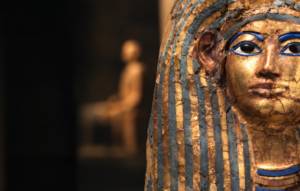
The recent theft of historical jewels from the Louvre Museum in Paris confirms what we believe to be the endangered status of cultural heritage in gold and precious stones. The heist is only the latest in a string of high-profile museum thefts of cultural heritage occurred in 2025 after our short research paper was published on SSRN in June this year. In September, a 3,000-year old gold bracelet belonging to Pharaoh Amenemope was stolen from a safe in the Egyptian Museum in Cairo by a restoration specialist and melted for its gold, a process that produced metal with a market value of just 4,000 dollars and an inestimable heritage loss. Also in September this year, historic specimens of native gold with a street value of about 600,000 euros as of 16 September but immeasurable historic, scientific and heritage value were stolen from the geology and mineralogy gallery of France’s National History Museum. A 24-years old Chinese woman who left France on the day of the theft was arrested in Barcelona on 13 October after attempting to dispose of nearly one kilogram of melted gold pieces and later charged in France with theft and criminal conspiracy.
Cases of museum thefts of cultural heritage in gold and/or precious stones have reached degrees of frequency, gravity, permanent loss, irreversible damage and destruction that demand immediate action. The time has come for cultural heritage in precious materials to be formally classed as “endangered” by law and treated and protected accordingly.

Mirta Aktaia Fava is an art consultant, international jurist, risk manager and interior designer active internationally. She graduated with a Master of Law (LL.M.) from the University of Cambridge, United Kingdom, and an M.A. in Political Sciences and International Relations from LUISS University, Rome, where she also held research and teaching positions. A published academic, she is an alumna of The Hague Academy of International Law and a former research fellow of the Italian Consiglio Nazionale delle Ricerche (CNR) and La Sapienza University Rome. She specialised in Art Market, Analysis of the Art Market, Art Law, and British Portraiture at the Sotheby’s Institute of Art, London, and in Antique Furniture at Christie’s Education, London. Prior to entering the art world, Mirta worked as a counterparty analyst and risk manager for some of the leading international financial institutions in the City of London.
***
Mirta Aktaia Fava è una consulente d’arte, giurista internazionalista, risk manager e interior designer attiva in ambito internazionale. Ha conseguito un Master in Diritto (LL.M.) presso l’Università di Cambridge, Regno Unito, e una laurea in Scienze Politiche e Relazioni Internazionali presso la Luiss di Roma, dove ha anche rivestito incarichi di ricerca e insegnamento. Ha al suo attivo diverse pubblicazioni accademiche e divulgative. È allieva dell’Accademia di Diritto Internazionale dell’Aja, Paesi Bassi, ed è stata borsista di ricerca per il Consiglio Nazionale delle Ricerche (CNR) e l’Università La Sapienza, Roma. È specializzata in Mercato dell’Arte, Analisi del Mercato dell’Arte, Diritto dell’Arte e Ritrattistica Britannica presso il Sotheby’s Institute of Art di Londra, e in Mobili Antichi presso Christie’s Education, Londra. Prima di dedicarsi al mondo dell’arte, ha lavorato come analista e manager del rischio di controparte presso alcune delle piu’ prestigiose istituzioni finanziarie internazionali della City di Londra.