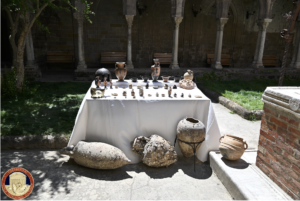
Raiders of the Gold Art: Lessons from the Villena and Vienna Museums Thefts
Recent Heists Confirm that Safes Are the Safest Option for Cultural Heritage in Gold and Precious Stones – “Endangered Heritage” Protocols, Safekeeping in Secret Locations, No Loans and Digital or Replica Display as Remedies against Thefts as Museum Security Is Now Perceived by Thieves as Less Robust than in Jewellery Stores
Contents: 1) Introduction – The Special Nature of Cultural Heritage in Gold and Precious Stones and the Drivers of the Recent Increase in Museum Heists in Europe; 2) Dynamics of the Villena and Vienna Thefts, Overview of the Stolen Items, and State of Security at the Museums Involved; 3) The 2026 Europol Report on Museum Heists and General Statistical Issues on Art Theft; 4) Conclusion – The Special Nature of Cultural Heritage in Gold and Precious Stones: “Endangered Heritage” Protocols, Safekeeping in Secret Locations, No Loans, and Digital or Replica Display as Remedies against Theft and Destruction
1) Introduction – The Special Nature of Cultural Heritage in Gold and Precious Stones and the Drivers of the Recent Increase in Museum Heists in Europe
The number of high-profile museum heists in Europe has dramatically increased over the past two years. The escalation has been particularly significant within the cultural heritage in precious materials and gemstones segment due to a feature that is unique to this category of artefacts and that in previous work we defined as the ability to retain part of its value if destroyed and termed “value retention power”. We explored this feature in detail in the first article of our “Raiders of the Gold Art” series, of which the present work represents the third “episode”. Written in April 2025, “Raiders of the Gold Art: Digitalisation and Digital Display as Remedies against the Theft and Destruction of Cultural Heritage in Gold and Precious Stones” , currently on the SSRN Library while being updated and expanded, highlighted how the processes of melting and unmounting transform hard-to-sell stolen cultural heritage into highly liquid commodities while at the same time concealing the illegal provenance of the precious materials obtained, and how both strategies imply the physical destruction of the original artefacts with the purpose of obtaining assets of lower but more marketable worth: while the artistic and cultural value of the original artefacts is lost forever, the economic value of their components is retained.
Our article also examined the galloping trend in thefts of cultural heritage in gold and other precious materials from museums worldwide with the purpose of determining whether the power of this type of cultural heritage to retain part of its value if destroyed represents an incentive to its theft and destruction, and therefore a cause of “endangered” status. Our conclusion was that it undoubtedly does, as it was later confirmed by the string of high-profile thefts that occurred after the article was written and made public. As remedial actions, we proposed to formally classify cultural heritage in precious metals and gemstones as “endangered heritage” and resort to safekeeping in high-security secret locations combined with digitalisation and digital display in museums as effective means of protection against theft and potential destruction. Our proposal to create a protocol for its protection as “endangered heritage” under international law, and possibly within a UNESCO framework, is contained in the final sections of this article, where we also propose the creation of a specific reporting category within future reports in the Interpol “Assessing Crimes against Cultural Property” series.
We have analysed a significant number of recent museum heists and their wider context in order to determine the drivers of the dramatic increase in high-profile thefts observed over the past two years, with particular regard to cultural heritage in gold and precious stones (for an overview of some of the cases examined prior to those assessed in this article, see those reported in our “Raiders of the Gold Art: Digitalisation and Digital Display as Remedies against the Theft and Destruction of Cultural Heritage in Gold and Precious Stones” (supra) and in our “Raiders of the Gold Art: The Louvre Museum Heist” published on the Journal of Cultural Heritage Crime (JCHC) on 22 October 2025). Emulation fuelled by weak museum security (opportunistic theft), material value of the gold artefacts deriving from the sky-high price of the metal in an increasingly uncertain and unpredictable international political environment, and possible “hostage taking” (return of the cultural artefact in exchange for a reward, either in financial form or as a future “guarantee” for suspended criminal proceedings or legal concessions) or use of artworks as “criminal collateral” (replacing cash as a guarantee for large loans between criminal organisations) in connection with thefts by criminal networks normally operating in sectors other than art stand out among the more established or traditional drivers such as theft for resale on the black market, theft on commission by collectors, or theft by criminals for “underworld prestige”.
Emulation fuelled by weak museum security might currently be the main driver. Several practitioners interviewed by Kevin Maimann for his “Recent art thefts appear to be inspired by 2025 Louvre heist, art crime experts say”, published on the website of American broadcaster CBC on 9 September 2026 – just hours after the theft of four artworks by Impressionist painter Pierre-August Renoir from a French museum – expressed their view that “last year’s headline-grabbing Louvre heist appears to have inspired a rash of brazen art thefts, putting European museums that hold valuable works in a difficult position”. Anthony Amore, an art theft expert and investigator based in Boston, Massachusetts, declared “In my twenty-odd years of doing this sort of work, I haven’t seen anything on this scale”. Erin Thompson, a professor of Art Crime at City University of New York, defined the recent museum thefts as “Louvre-inspired.” Their comments ensued an extraordinarily concentrated series of high-profile museum heists in Europe, where in a matter of days the theft of the Renoirs in France (8 September 2026) followed the thefts of Old Master paintings by Antonello Da Messina from a Museum in Italy (15 August), of the Bronze Age Treasure of Villena and other gold artefacts from a museum in Spain (27 August), and of an important platinum and diamonds necklace on loan to a museum in Austria (also on 27 August).
This article examines the Villena and Vienna museum heists in detail as well as within their wider context and proposes remedial actions for the protection of cultural heritage in precious metals and gemstones.
2) Dynamics of the Thefts, Overview of the Stolen Items and State of the Security at the Museums Involved
a) The Museum of Villena
Dynamics of the Theft
In the latest of a string of high-profile museum heists executed in Europe over the past few years, in the early morning of 27 August 2026 thieves entered the local museum of a small town in the Spanish Province of Alicante and raided one of the world’s largest and most significant collections of gold artefacts from the Bronze Age, the Treasure of Villena, along with four crowns of the Virgin of the Virtues and the Christ Child. Three silver vessels, an iron bracelet and decorative elements of the “Kingfisher staff” from the hoard were intentionally left behind, while one of the devotional crowns was lost by the thieves whilst leaving the museum premises, a detail oddly coinciding with the dynamic of the robbers’ escape from the Louvre last year.
The theft was performed in just four minutes, facilitated by an alarm triggered few minutes earlier at the town sports centre in what local authorities suspect to have been a diversion. According to the town council spokesperson, the museum alarm rang at about 5:20 am while the building was unmanned and the thieves left the premises undisturbed at 5.24 am despite all security systems being activated and operational. Information released by the Spanish Government’s deputy representative in Alicante, Manuel Pineda, indicates that the robbers arrived at the museum in more than one vehicle and entered the building through a window. Various media sources report that they tried to force a door open first. An article by Inma Lidón entitled “De Albacete a Villena: dos robos profesionales de piezas de oro por encapuchados en pocos minutos y con un mes de diferencia” published on the website of Spanish newspaper El Mundo on the day of the heist refers that three hooded thieves (six according to other sources) were caught by the museum security cameras and that recordings show them acting professionally and with knowledge of their surroundings. Professor Mauro Hernandez of the University of Alicante believes the heist had been planned in detail since thieves knew exactly how to enter and how to escape the structure.
The hoard had been on display in a designated room of the newly opened Museum of Villena (MUVI) since May 2024. Citing Antonio M. Poveda, a former director of the nearby Archaeological Museum of Elda, an article by Vincente Olaya and Rafa Burgos entitled “El Tesoro de Villena pasó de una cámara acorazada al museo recién remodelado en 2024” published on the website of Spanish newspaper El País on 27 August 2026 reports that during the renovation works of the new museum building the treasure was kept in the vault of a local bank, and that prior to that it was stored in the strong room of the old museum, where it was guarded by a custodian. Citing the same source, the article also reports that at the time of the discovery of the hoard the Spanish central government had manifested the intention to take it to the National Archaeological Museum in Madrid but had later renounced following popular revolt, on condition that the original treasure would be kept in a strong room, that it would never be displayed, and that an exact copy would be exhibited to the public. These strict conditions were observed until the new museum was inaugurated. The practice of keeping the original gold pieces in a bank vault and displaying exact copies is adhered to by some Spanish local museums such as the Museum of Seville ( tesoro tartésico del Carambolo) and the Museum of Zamora (celtibérico de Arrabalde).
The security arrangements described by Puveda as being in place before the inauguration of the new museum are incompatible with those reported in an article by José Luis Fernandez entitled “Un museo de cuatro millones y un sistema de alarmas auditado que fue revetado por una banda organizada” published online on Spanish newspaper ABC on 28 August 2026. Citing municipal employees as a source, Fernandez reports that before the new museum was inaugurated in 2024 the treasure had been on display in the building of the City Hall (Ayuntamiento) “ in a chest with a display case that did not meet the minimum security conditions” and that over four million euros had been spent in the conversion of an old industrial building into the new Museum of Villena – an institution merging the collections of the old Municipal Archaeological Museum ‘José María Soler’ (1957-2019) and the large ethnographic collection donated by Jerónimo Ferriz Hernández – to provide a secure location.
Just few days before the theft, the director general of the Spanish Fine Arts, Ángeles Albert, had requested all museums in Spain to issue reports on the state of their security measures. Two Spanish museums had been raided in the preceding months: on 27 July 2026, thieves had stolen 220 XIX Century gold coins owned by the Spanish Ministry of Culture from the Provincial Museum of Albacete, where they were displayed in the context of an itinerant exhibition; three months before, on 25 April, thieves had raided, in just one minute, 149 gold coins belonging to the Treasure of Villanueva de la Serena displayed in the Provincial Archaeological Museum of Badajoz.
Overview of the Stolen Items
I – The Treasure of Villena
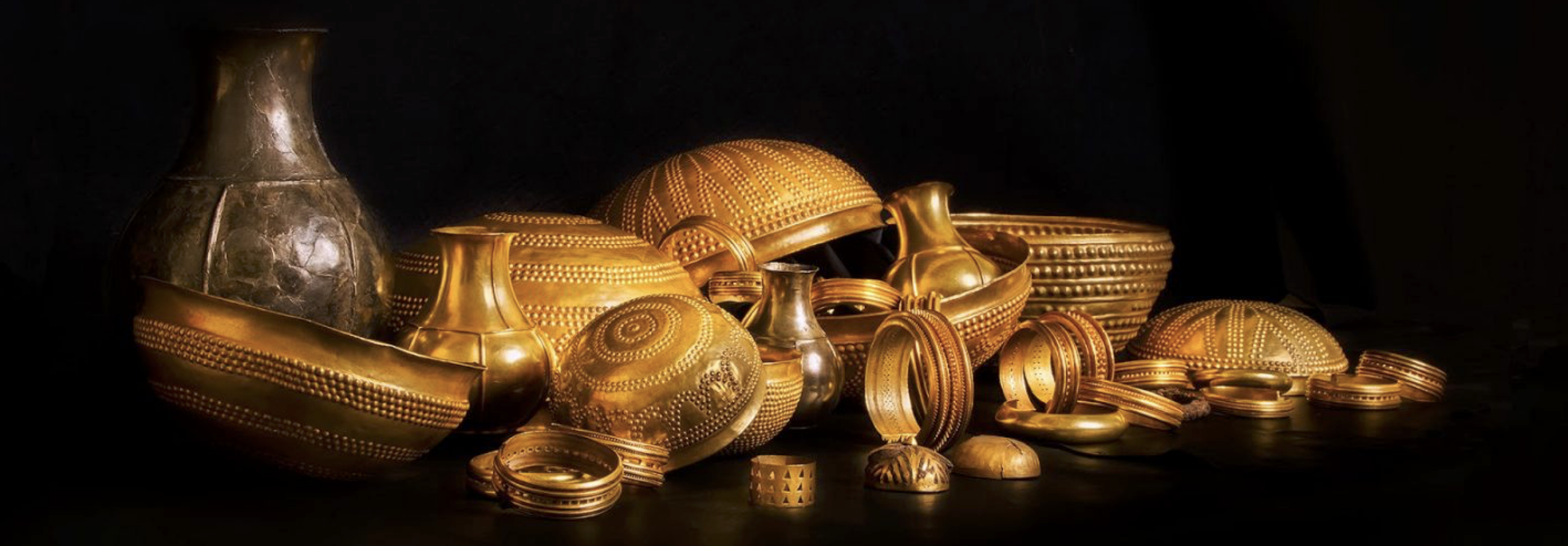
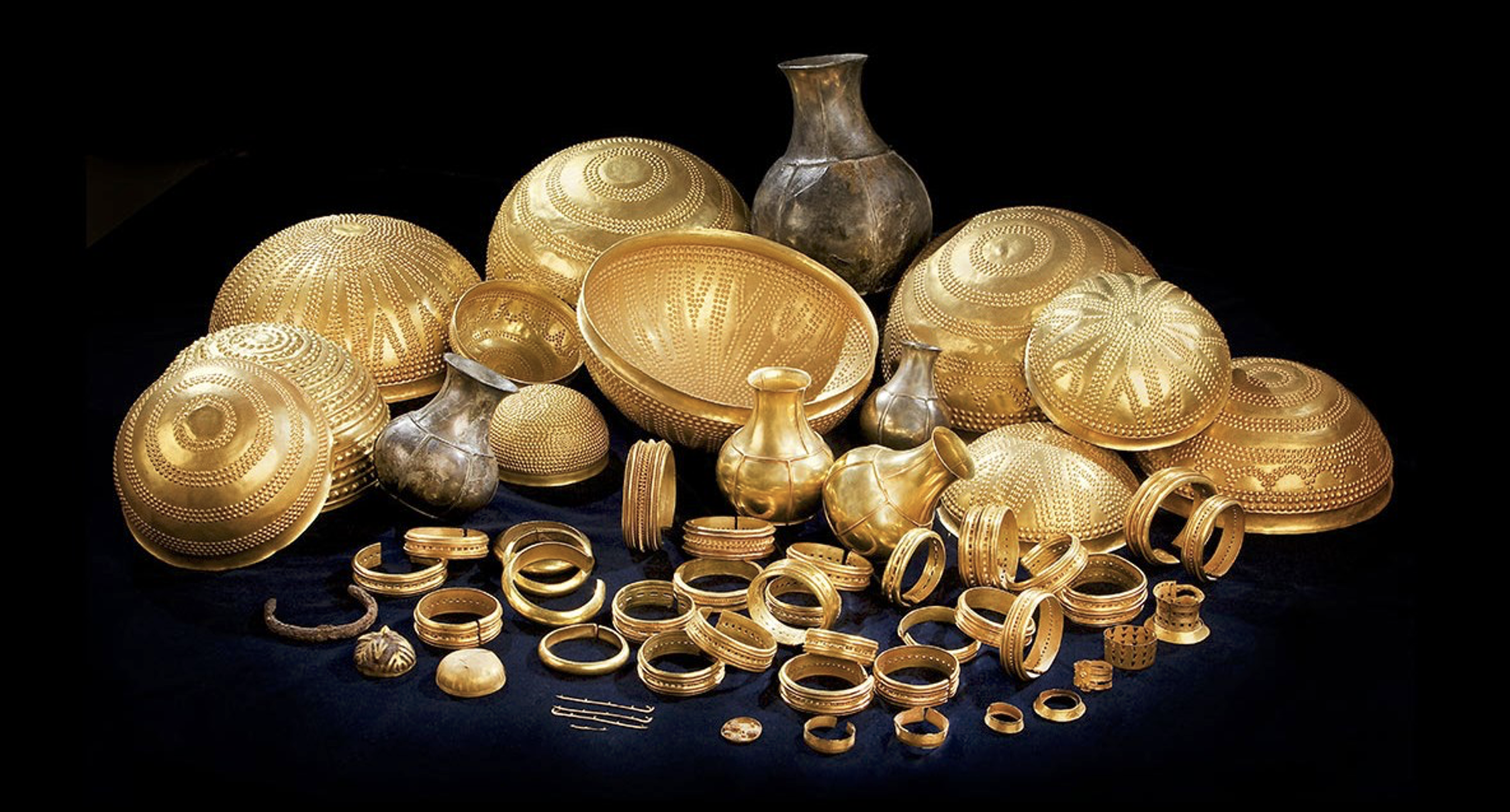
Discovered in December 1963 in the sands of a dried riverbed by archaeologist Jose Maria Soler and considered one the most important Bronze Age treasures in Europe, the Treasure of Villena consists of 59 or 66 artefacts (variations in the official number depend on whether only the objects or also their individual components are counted) in precious metals dating back to about 1,000 B.C. As of 27 August 2026, the Museum website described the artefacts as 11 gold bowls, 28 gold bracelets, three gold bottles (we note that only two gold bottles are visible in official pictures of the hoard) and several miscellaneous pieces all made of gold, as well as three bottles made of silver, two items in mixed materials (a button made of amber and gold, and a finial in the shape of a hemisphere in gold and iron) plus a bracelet entirely made of iron, a metal that was not yet smelted in the Iberian Peninsula during the Bronze Age.
According to research by S. Rovira-Llorens, M. Renzi and I. Monyero Ruiz published in Trabajos de Prehistoria Vol.80 n.2 (2023) entitled “¿ Hierro meteoritico en el Tesoro de Villena?” and conducted using mass spectrometry, the finial and the iron bracelet were highly probably crafted using extremely rare meteoritic iron. This would explain their inclusion, at the time of the hoard burial, within a treasure consisting mainly of gold artefacts.
Michelle Starr’s “Rare Ancient Treasure Trove Stolen – But Thieves Left The Most Valuable Item Behind” published on Science Alert on 3 September 2026 reports that research on the provenance of the meteoritic iron indicates that the metal, and possibly the Treasure of Villena itself, could have originated in the Eastern Mediterranean, where a significant number of other ancient artefacts made from meteoritic iron have been excavated. The use of extra-terrestrial metal in civilisations based in the Eastern Mediterranean is synthetically covered in an article by Ivan Farkas “Metal From Beyond Our World Found in Rings Worn by Ancient Mediterranean Elites” published on Science Alert on 13 August 2026. Ten years ago, research by Italian and Egyptian scientists published in the Journal Meteoritics & Planetary Science in May 2016 had confirmed, through portable x-ray fluorescence spectrometry, the meteoritic origin of the iron used for the dagger blade from the sarcophagus of the ancient Egyptian Pharaoh Tutankhamun (14th C. BCE).
According to M. Hernandez Perez, G. Garcia Atienzar and V. Barciela Gonzalez’s “The Treasures of Villena and Cabezo Redindo (Alicante Spain) published in H. Meller, R. Risch, E. Pernicka (editors) Metals of Power – Early Gold and Silver (pp.593-610), 2014, the gold items in the Treasure of Villena weight 9.754 kg in total, while the three silver bottles have a combined weight of 620 grams. While the heritage value of the Treasure is incalculable, its current value in gold is estimated to be in the region of 1.7 million euros (approximately 1.45 million British pounds). The fact that the silver and iron artefacts were ignored and only the objects made of gold were stolen indicates a theft highly probably driven by the material value of the metal. This implies a high risk that the 3,000 years old artefacts might be melted and therefore irreversibly destroyed.
As widely reported by Spanish and international media, on the day of the heist the Mayor of Villena Fulgencio Cerdán stressed the cultural heritage status of the hoard and the importance that the treasure has for the people of Villena. While visibly moved, he expressed the hope that it may be recovered intact. The Treasure of Villena is designated as Patrimonio Historico Nacional (National Historical Heritage). The theft, which has reignited the debate on whether cultural heritage of exceptional importance should be kept in local museums according to the “principle of proximity” or centralised within national institutions with stronger security, is being investigated by the Unidad Orgánica de la Policía Judicial (UOPJ) of the Guardia Civil of Alicantewith the supportof specialised national units. The current debate on centralisation in Spain is covered in Ángel Mora, “¿Todo el patrimonio a Madrid?: el robo en Villena agita la polémica sobre la descentralización de los tesoros arqueológicos”, El Espanol, 6 September 2026.
II) The Crowns of the Virgin of the Virtues and the Christ child
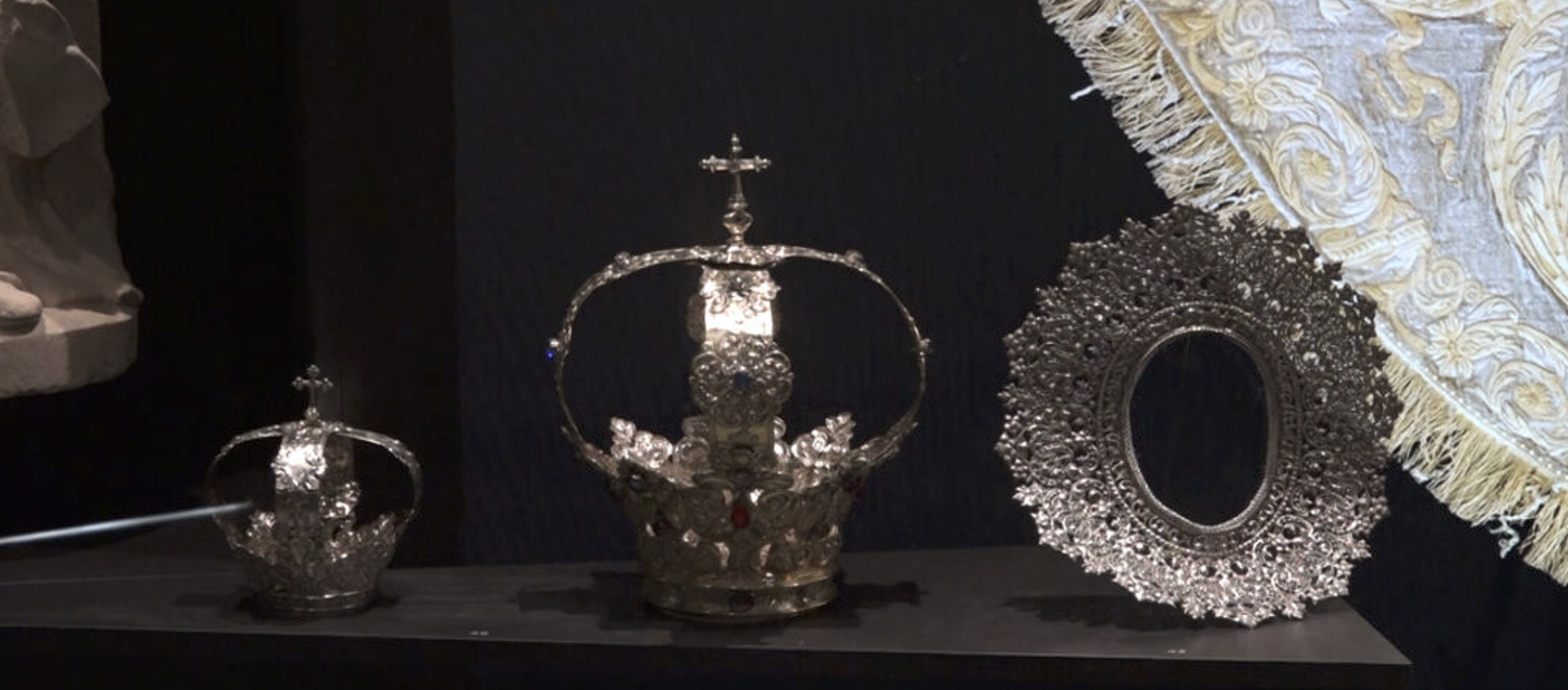
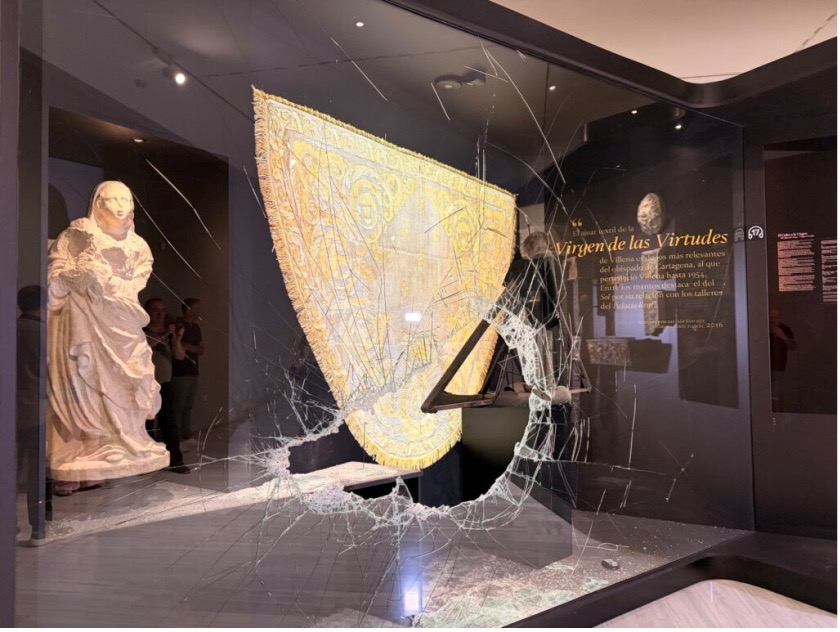
Along with the gold objects from the Treasure of Villena, the thieves stole four crowns in precious metals belonging to the statue of the patron of the town, the Virgin of the Virtues and the Christ Child. In a dynamic identical to that observed in the theft of the French Crown jewels at the Louvre less than a year earlier, one of the crowns – said to be the silver one of the Christ Child – was accidentally dropped by the robbers while leaving the museum premises and later retrieved by investigators.
There is considerable confusion among internet sources regarding the origins and history of the Virgin of the Virtues of Villena crowns, with some of the crucial information contained, for example, in the Intercomarcal Television report on the jewels of the Virgin of Las Virtudes of 1st September 2020 being significantly in contrast with that narrated, for example, in an essay by Fernando Costa Vidal dedicated to the 75thanniversary of the Virgin’s coronation in 1998 published on www.villenacuentame.com on 28 May 2026. What is certain is that the four devotional crowns formerly on display at the Museum of Villena belonged to two different sets: an ancient pair in silver dating back to the end of the XVII/ beginning of the XVIII Century, and a more recent pair in gold created in the early Twenties of the XX Century for the 1923 Coronation.

The gold crowns were produced by Valencian goldsmith Manuel Orrico on commission from the Town of Villena and on the basis of a highly symbolic design approved by the municipal government. Their creation was financed with funds raised via a popular subscription to which citizens contributed with either money or jewellery. The two crowns are said to have a combined weight of 4,953 grams, of which about 2,000 grams (2 kilos) consist of gold.
Made of gold, silver, enamel, pearls and precious stones, the crown of the Virgin is imperial in shape and Renaissance in style. Enamelled details in between stylised white lilies reproduce six imperial lilies, two of which with the arms of the Pope and the local Bishop and the other four depicting scenes of the appearance of the Virgin in Villena as represented in ancient prints. The crown is surrounded by a striking diadem with 23 rays, one of which ending with a cross and twelve with stars. Seven medallions made of chiselled gold bear female busts representing the three theological virtues (Faith, Charity, Hope) and the four cardinal ones (Justice, Prudence, Fortitude and Temperance). The bust representing Charity is positioned centrally and is surmounted by the Marian monogram. Twelve other enamelled details related to the Virgin are positioned in the lower part of the crown and between the arches encrusted with pearls or gemstones. Two chiselled angels and a dove pending from a chain positioned at the centre of the crown are among other elements composing the decorative scheme. Through the decades, the crown has been subject to additions in the form of medals and new enamelled details.The gold crown of the Christ Child is decorated with six imperial lilies and six angels with open wings supporting a globe surmounted by a cross.
While the economic value of the 2 kilograms of gold contained in the artefacts is considerable, their devotional and cultural value is incalculable: these masterpieces of Spanish goldsmithing had been used to adorn the statue of the Virgin of the Virtues (locally nicknamed “La Morena”) in the yearly procession that takes place in Villena in the month of September in the context of the local Festival of Moors and Christians. The origins of the festival have been traced back to the late XV Century, when the Virgin was proclaimed Patron of the Town and saviour of the plague. The website Moros y Christianos de Villena reports the centuries old history of this “unique civic involvement passed down through generations” classing it as identity and living heritage. Moors and Christians festivals in Spain have been declared by the State events of national tourist interest.

The Tesorillo del Cabezo Retondo, a small hoard of 35 pieces of jewellery from the Bronze Age also on display at MUVI was left untouched.
State of Security at the Museum of Villena
The thieves entered the Museum of Villena at around 5:20 am of Thursday 27 August taking advantage of a diversion tactic that led the Police to the Municipal Sports Centre first. After failing to force a door open, they entered the building through a lateral window with bulletproof glass of which they removed the frame from the wall. The security arrangements in place at the museum were illustrated in a press conference held at the venue the day after the heist. Our main sources for the contents of the event are the above mentioned ABC article by Fernandez and an article by Carlos Prats entitled “El MUVI, un museo que cumple toda la normative de securidad” published online on El Periodico De Villena on 28 August 2026.
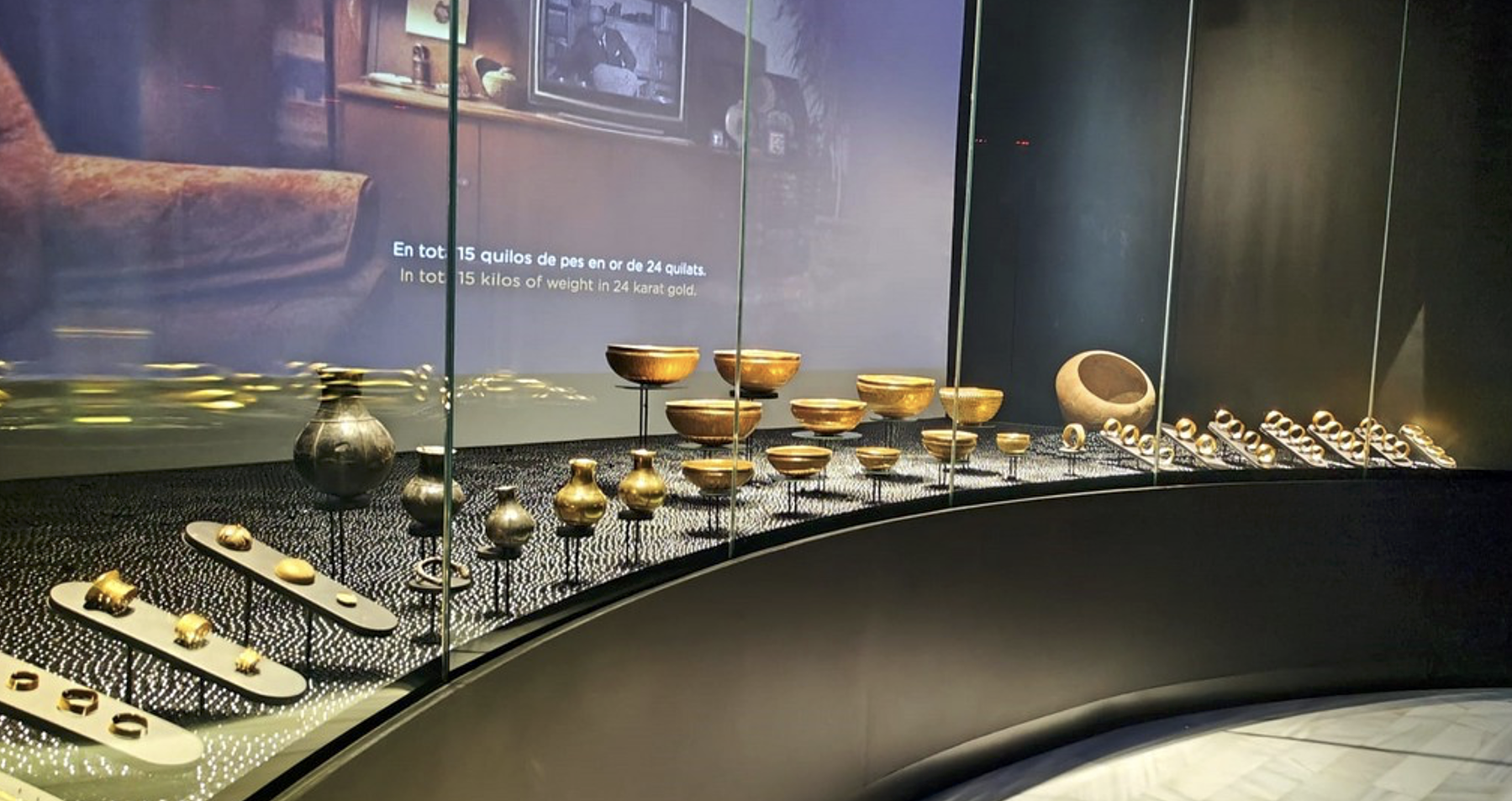
The Treasure of Villena was displayed in a three-meter high, 75 cubic meters (25 sqm x 3m) strong room with armoured walls and roof. The lateral walls were protected by 3mm steel plates reinforced with high-security glass, while the rear wall was protected by 6mm steel plates. The armoured roof was double-layered, while the window of its display case was protected by high-security monolithic tempered glass with a 10+10 mm interlayer and a specific security rating against manual attack. The strong room had a reinforced security door with a five-point locking system the key of which was changed periodically and could be accessed only by two people. The alarm system of the museum had a concentric design, with five different rings of protection covering the exterior and the interior of the building as well as specially protected areas, all equipped with surveillance cameras with night vision. When the building was inaugurated in 2024, the institution opened to the public with a Level 3 security system. The last security inspection had been successfully performed on the 3rd of August this year.
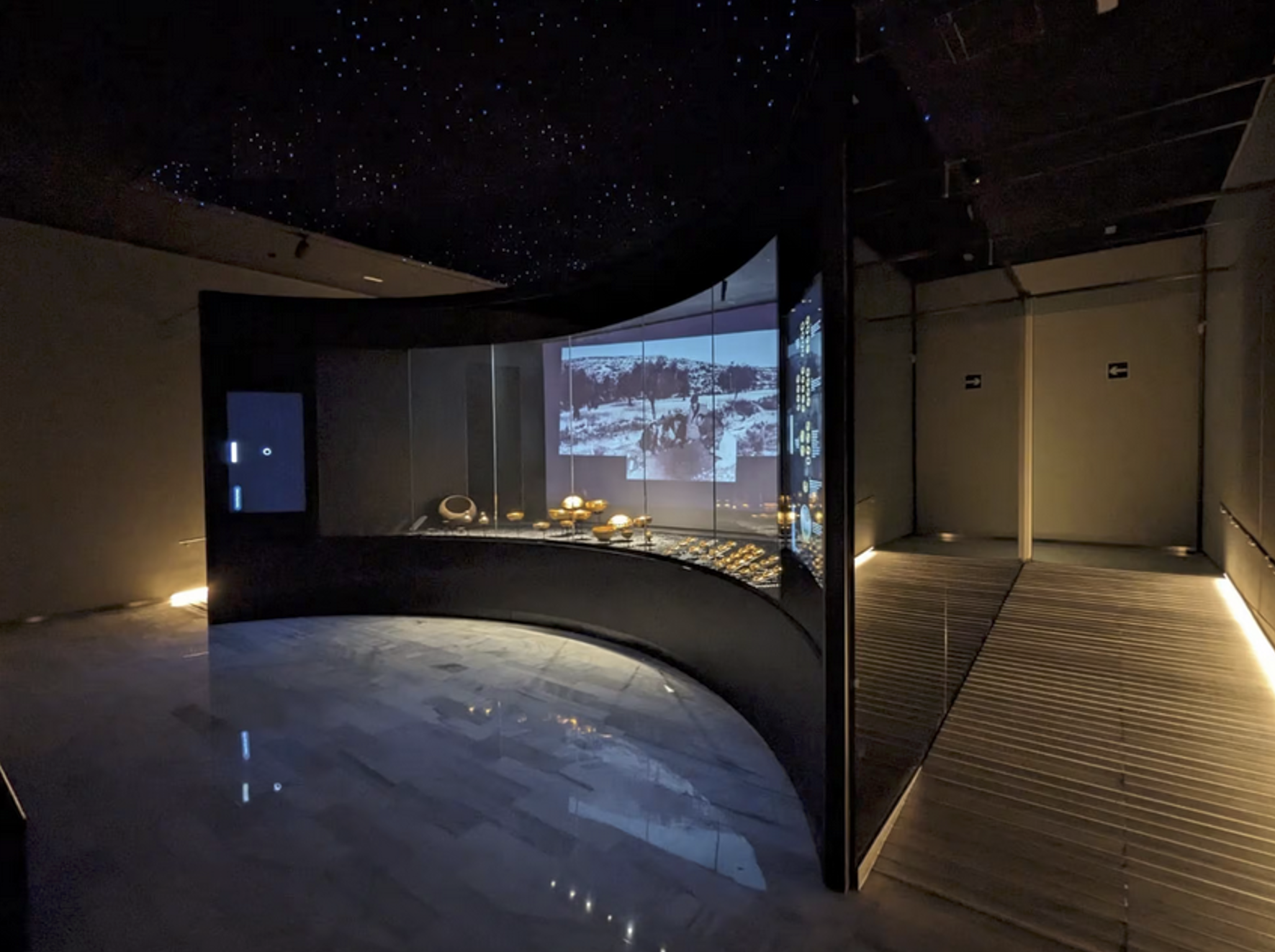
At the time of writing it is unclear how exactly the thieves shattered the bullet-proof glass of the Treasure of Villena strong room to gain access to the contents of the display case, shattered the glass of the display containing the crowns of the Virgin of the Virtues and the Christ Child and could complete the heist in a total of just four minutes despite the amount of security in place. It appears to be unanimous opinion among Spanish authorities that the theft was planned in detail and perfectly executed by a group of specialised professionals with precise knowledge of their target. The building was unmanned at night and robbers appear to have had knowledge of the museum cleaning schedules as well as of the shifts of maintenance staff. This paves the way to the possibility that the heist might have had an insider component. They acted in the dark, with the support of flashlights.
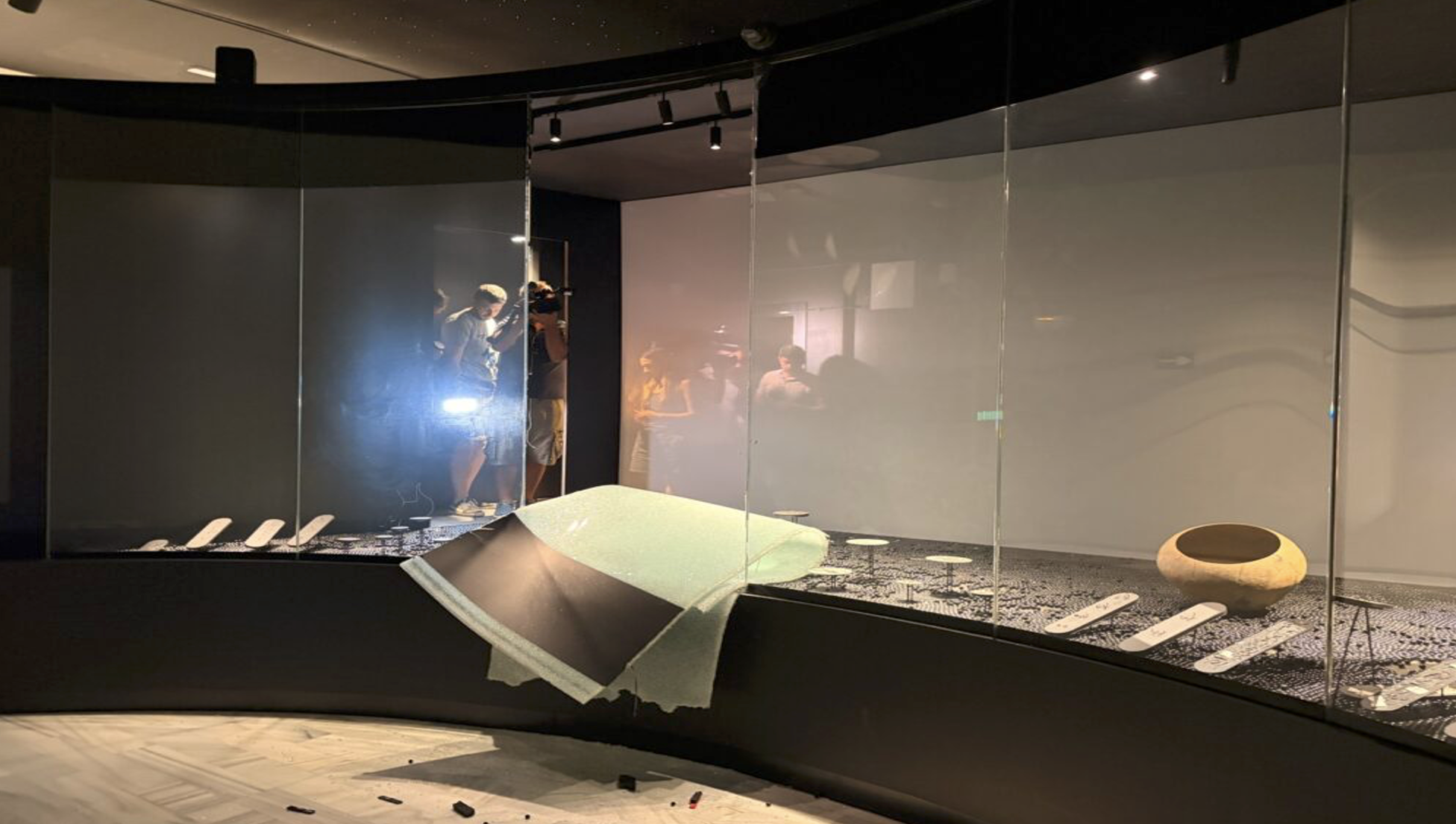
Polemic is raging over the Museum stating, during the press conference, that its security system “functioned perfectly”, as it is manifest that it did not. The fact that all security measures had been activated and were operational, that the cameras and the sensors detected the thieves and that the alarm system alerted police did neither prevent nor hamper the theft, as evidenced by the negligible amount of time required for the robbers to enter the museum premises and walk away, undisturbed, with a treasure.
According to an article by Nancho Segura, “Un informe policial advirtió al Ayuntamiento de Villena de las brechas de seguridad del museo antes de exhibir el Tesoro”, published on El Debate on 4 September 2026, on 10 June 2024, few days before the MUVI inauguration, a report by the Autonomous Police had warned the institution about a number of security weaknesses and had recommended the permanent presence of Local Police or private security personnel 24/7. Apparently, the measure was not implemented for cost reasons.
The Council of the City of Villena has established a commission in charge of investigating the theft, the security system, and the whole process that, beginning from 2009, led to the creation of the new Museum of Villena. Details are reported in Iván Jiménez, “Villena reconoce que la seguridad del Tesoro fue “insuficiente”: crea una comisión para investigarlo”, CastéllonPlaza, 2 September 2026 and “Villena aprobará la creación de una comisión sobre el proyecto del Museo de Villena desde 2009” (Culturplaza, 2 September 2026) by the same author.
b) The Vienna Museum of Applied Arts (MAK)
We report on this museum theft very synthetically as we consider the stolen object cultural property of insufficient historical relevance to be treated as cultural heritage. The theft is nevertheless significant with regard to the wider issues of museum security and loans.
Dynamics of the Theft – Few hours after the Museum of Villena heist, in the afternoon of 27 August 2026 two unmasked thieves posing as visitors smashed a display case containing a platinum and diamond necklace on loan to the Vienna Museum of Applied Arts (MAK) for the exhibition on jewellers Van Cleef & Arpels. After seizing the necklace, they left the museum premises undisturbed and fled towards a nearby park (see, among other media sources, Bethany Bell, “Thieves steal 600-diamond necklace from Vienna museum in broad daylight”, BBC website, 28 August 2026, and Deborah Cole, “Egyptian queen’s 673-diamond necklace stolen in Vienna smash-and-grab raid”, The Guardian, 28 August 2026).
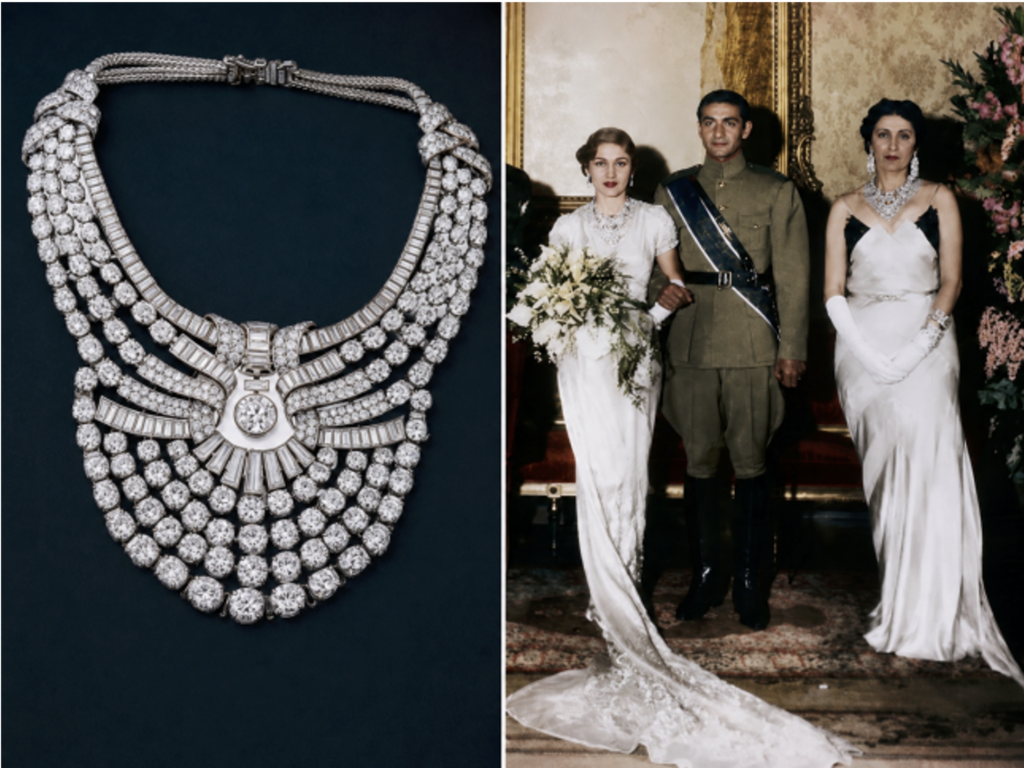
Overview of the Stolen Items – The stolen object is, or perhaps was, a platinum necklace with 673 diamonds and over 200 carats designed by Van Cleef & Arpels for the former Royal Family of Egypt. The jewel was worn by Egyptian Queen Consort Nazli for the marriage of her daughter to the future Shah of Iran in 1939 and has some historical importance. Defined by its creators a “triumph of white jewellery”, it has an estimated value of about $4m (£3m; €3.5m).
State of Security at the MAK – According to the BBC (supra), the MAK general director Lilli Hollein declared in a statement that the museum had developed a security plan with Van Cleef & Arpels specifically for the exhibition, that “security issues were taken very seriously and all security measures were carefully prepared” and that the museum had thoroughly reviewed its security measures ahead of the exhibition, “particularly in light of the incidents at major museums in recent years“. The ease and speed at which the criminals conducted the theft in broad daylight while visitors were present and fled undisturbed requires no comment regarding the quality of the security measures adopted. At the time of writing the necklace has not been retrieved.
3) The 2026 Europol Report on Museum Heists and General Statistical Issues on Art Theft
The 2026 Europol Report
Only three days before the theft of the Treasure of Villena, on 24 August 2026 Europol had published a spotlight report on cultural property theft entitled “Changing tactics, changing targets: the evolving nature of museum heists” (“The 2026 Europol Report”). The report highlights what the organisation considers to be a shift in methods and targets from traditionally non-violent thefts based on deception and discreet execution to increasingly aggressive, more direct and confrontational approaches, including violent means, with an increasing focus on items in precious metals and /or gemstones with high material value and artefacts with significant cultural relevance, including ancient Chinese porcelain.
The document also notes that, across reported cases, “Alongside changing tactics, the targets of museum thefts have also evolved. Over the past two years, precious metals and stones have been frequently targeted” (page 6 of the report) and that financial considerations (material value and market demand) represent the primary driver in the selection of targets, with items in gold and precious stones “attractive to criminal networks due to their visibility, accessibility, and the perception that museum security measures are less robust than those in jewellery stores” (page 7). It also notes that the profile of the perpetrators is evolving, with thieves often selected on an ad-hoc basis among individuals with prior experience in other types of crimes, often recruited locally through social media or instant messaging channels, a practice in stark contrast with the traditional, structured organisation of criminal networks specialised in the trafficking of cultural goods. Nevertheless, “the use of force is closely linked to targeted operations, suggesting prior identification of specific objects and pre-planned execution” (page 5).
The Europol report on the evolving nature of museum heists references, in note n.2 , page 4, our article “The Theft of the Golden Helmet of Cotofenesti: Analysis and Scenarios” published on the Journal of Cultural Heritage Crime (JCHC) on 7 February 2025. In that article, we expressed the opinion that “outstanding pieces of cultural heritage of exceptional artistic, historical and symbolic value should be considered unmovable, and that this principle should apply both nationally and internationallyin order to preserve their integrity and existence”. Since then, the number of museum thefts of cultural heritage objects in precious metals and gemstones – including items on loan- has multiplied, affecting even institutions of the size and importance of the Louvre Museum. The increase in frequency led to the transformation of our April 2025 article “Raiders of the Gold Art” into a series of which this essay represents the third “episode”.
General Statistical Issues on Art Theft
About a year before the publication of the 2026 Europol Report, exploratory statistical research at a very early stage by Sandra Clopés and Marc Balcells focused on building a methodology for the creation of a very much needed analytical database on art theft and entitled “The Science of Art Theft: Using Data to Identify Criminal Patterns, 1990–2022” published its premature results on the International Journal of Cultural Property , Volume 32 , Issue 2 , May 2025, pp. 105 – 13. By the authors’ own admission, the research was extremely limited in scope being based only on 40 cases (slightly more than just one case for each year within the 32-year time period covered) which had occurred solely in Indo-European languages countries and only on data obtained from open-source research. Nevertheless, the paper affirms in its abstract that “Results indicate thieves tend to use brute force to defeat security measures; diversions and deceptions are a standard, uniform trends are present in absolute timing matters, and neither the use of weapons nor insiders appears to be the norm”.
The content of the latter statement on the use of weapons or insiders appears unreliable in relation to insiders for two reasons in particular:
1) law enforcement agencies statistics and practitioners estimates affirm that over 80% of museum thefts have an insider component. These figures result from calculations based on a broad, established concept of insider / internal participation that classifies as “insider job” or “insider component” any museum insider’s action, oversight or omission that contributes to or results in a theft. These actions and omissions range significantly from human error to direct theft or conspiracy and include, but are not limited to, intentionally or unconsciously leaking operational and security details, bypassing standard protocols and passively enabling theft by – for example – maintaining unregistered inventories or ignoring warnings.
In 1998, an internal study by the US Federal Bureau of Investigation (FBI) found that 83% of museum thefts were inside jobs. This study is discussed by John Kerr on pages 32 and 33 of his doctoral thesis “The securitization and policing of art theft in London” (2013) – later published by Routledge in 2016 – by referencing works by Simon Houpt and Arthur Tijhuis. Kerr observes correctly that the figure “relates to art thefts that have been solved” and not to art thefts in general.
Retired FBI agent and founder of the Bureau’s Art Crime Team Robert Wittman, who in his twenty years of activity with the FBI recovered more than 225 million dollars in stolen artefacts in twenty different countries, has estimated on the basis of his decades-long experience that 90% of museum thefts are “an inside job,” a claim recently reported in Roselyn Romero’s “Can Oakland’s stolen museum artifacts still be recovered? A former FBI art crime sleuth says yes”, published on The Oaklandside website on 7 July 2026. Wittman, who retired from public duty in 2008 but remains active in the field through his security and art recovery consulting firm, had already stated nearly twenty years ago that “About 90 percent of art thefts from museums are internal” while speaking at the 2008 National Conference on Cultural Property Protection sponsored by the Smithsonian Institution as quoted in Susan Mandel’s “Insider Theft, Fires, and Vandals Top List of Museum Concerns” published on the website of Security Management on 1st June 2008.
This experience-based statistic has of course the limit of relying only on known or solved cases; since it provides no data-set, could in theory be considered a zombie statistic but the fact remains that the source is highly authoritative and that currently no credible data sets that contradict it exist;
2) cases investigated from 2023 onwards indicate the existence of several high-profile museum thefts where artefacts were stolen by insiders or with the contribution of insiders. These cases include but are not limited to: the theft of over 2,000 coins, gemstones and items of ancient jewellery from the British Museum in London by a Senior Curator over several years (discovered 2023); the theft from a safe of the Egyptian Museum in Cairo and subsequent melting, for a material value of just about 4,000 US dollars, of a 3,000-year-old gold and lapis lazuli bracelet belonging to Pharaoh Amenemope by a restoration specialist (2025); the theft of four paintings by Antonello da Messina from a museum in Sicily, where one of the custodians is now investigated following inconsistencies in his account of the events (2026).
This poses the question “who protects art museums from themselves?”. The matter has been briefly covered in a short note with a similar title by Lily Elkwood published on the Center for Art Law website on 15 February 2024. Precautionary and repressive measures ”to prevent, detect, delay, and respond to theft” by accidental or malicious insiders based on insider threat analysis have been explored, among others, by security expert Kim Covent in her “Insider Threat in the Art World. Theft of Art and Heritage Objects from Museums with Inside Help” (11 December 2023). Kunstcriminaliteit – Cahiers Politiestudies, No. 69 (2023), pp. 121-138, Gompel & Svacina BV.
General statistical issues also arise with regard to the categories of stolen art and cultural heritage objects reported in official sources as no specific statistics appear to exist in relation to cultural heritage in gold and other precious materials. Gaps exist even in one of the most authoritative statistical tools in the field of art crime, the periodic Interpol report on crimes against cultural property.
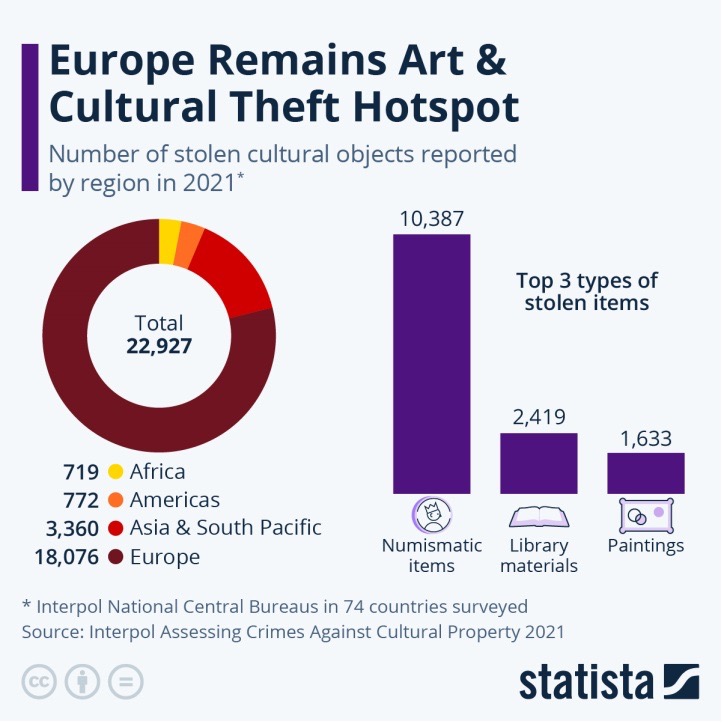
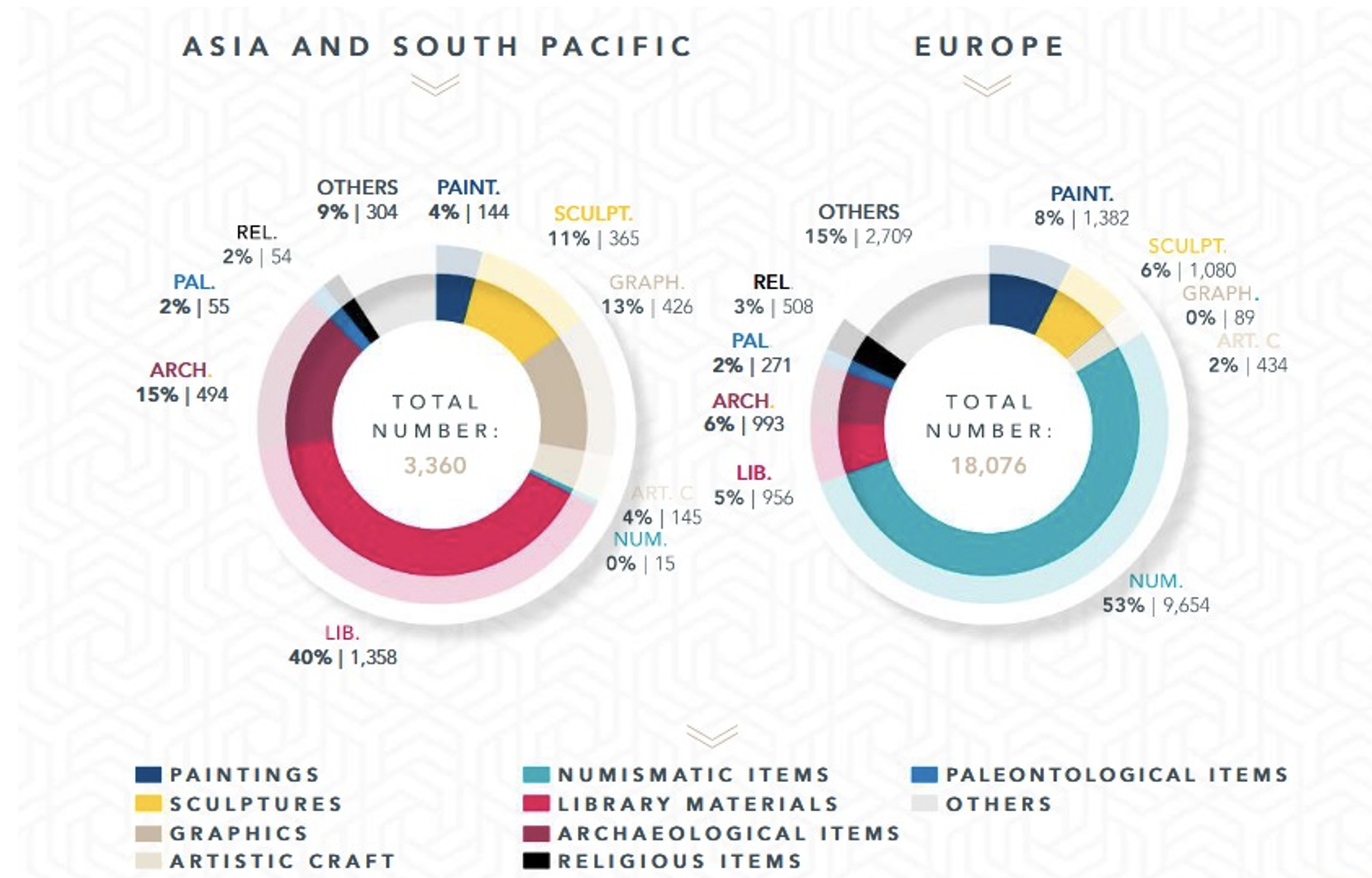
In its report “Assessing Crimes against Cultural Property 2021” published in October 2022 (this is the most recent version available at the time of writing) Interpol calculated a total of 22,927 cultural objects stolen across the 74 countries surveyed globally. Of these, the vast majority (18,076) were stolen in Europe. A comparative analysis of their breakdown with that of the previous two years (page 10 of the report) revealed that “Numismatic objects were the most frequently stolen in Europe in 2021 (9,654), as was the case in 2020 (9,675) while archaeological items headed the list n 2019 (17,607)”. A pie chart on page 11 of the report illustrating thefts by category showed that numismatic objects accounted for 53% of total cultural heritage thefts in Europe, with the category “others” in second place accounting for 15%.
An exam of the classification adopted by Interpol for its itemisation of thefts (ibidem) reveals the absence of a specific category for cultural heritage objects in gold and other precious metals or gemstones, being the thefts of this type of artefacts spread over other categories, such as “numismatic”, “archaeological” and “other”. In light of the recent surge in thefts of cultural property in precious materials, we propose the creation of a specific reporting category within future Interpol reports in the “Assessing Crimes against Cultural Property” series.
Conclusion -The Special Nature of Cultural Heritage in Gold and Precious Stones: “Endangered Heritage” Protocols, Safekeeping in Secret Locations, No Loans and Digital or Replica Display as Remedies against Theft and Destruction
A key driver in the recent surge in museum heists targeting cultural heritage in precious metals and gemstones is the ability, unique to this category of artefacts, to retain part of its value if destroyed. We have termed this particular feature “value retention power”. The retention of material value is an incentive for the destruction of artefacts via melting and unmounting, an element that, in our opinion, places cultural heritage in precious materials in the “endangered heritage” category.
In light of the theft dynamics and museum security issues observed in the substantial number of cases examined or referred to in our “Raiders of the Gold Art” series and in our assessment of the theft of the Golden Helmet of Cotofensti, as well as the economic unsustainability of 24/7 armed security for most museums, we believe the following measures could be effective in ensuring a higher degree of protection for cultural heritage in gold and other precious materials. Proposed solutions:
– creation of “Endangered Heritage” Protocols under international law, and possibly within a UNESCO framework, detailing security measures and policies to be adopted by museums worldwide;
– safekeeping in centralised, cost-efficient high-security secret locations – Even in this context, insiders would continue to represent a threat and should be managed accordingly.
– digital or replica display – The fundamental weakness of museum security paired with the power of cultural heritage in precious materials to retain some economic value if destroyed pose the question of whether this category of cultural heritage should be displayed in museums at all as its display increases not only the risk of theft but also that of destruction. Existing technology allows for bi-dimensional and tri-dimensional reproduction and display of virtually any type of cultural heritage artefact, with the distinctive advantage of creating immersive experiences for museum visitors while at the same time ensuring the protection of artefacts and artworks that are too fragile or, as in the case of cultural heritage in precious materials, at high risk of theft;
– “no loans” policy – With access to international travel now widespread and largely affordable, and advances in technology that allow universal visual access to cultural heritage worldwide in just a few clicks, the reasons ordinarily given in support of the loan of artworks appear weak. We believe that permanent residence for any outstanding pieces of cultural heritage of exceptional artistic, historical and symbolic value should be the rule.
For analytical purposes, we also propose that statistical sources such as the periodic Interpol report “Assessing Crimes against Cultural Property” classify cultural heritage in gold and other precious materials in a reporting category of its own.
It is our intention to treat the proposed solutions in more detail in future research.
Mirta Aktaia Fava 12 September 2026
AI disclaimer: The author has not resorted to artificial intelligence at any stage of the research or of the creation of this manuscript. The sources in languages other than English have been read in their original language without the support of automated translation tools.

Mirta Aktaia Fava is an art consultant, international jurist, risk manager and interior designer active internationally. She graduated with a Master of Law (LL.M.) from the University of Cambridge, United Kingdom, and an M.A. in Political Sciences and International Relations from LUISS University, Rome, where she also held research and teaching positions. A published academic, she is an alumna of The Hague Academy of International Law and a former research fellow of the Italian Consiglio Nazionale delle Ricerche (CNR) and La Sapienza University Rome. She specialised in Art Market, Analysis of the Art Market, Art Law, and British Portraiture at the Sotheby’s Institute of Art, London, and in Antique Furniture at Christie’s Education, London. Prior to entering the art world, Mirta worked as a counterparty analyst and risk manager for some of the leading international financial institutions in the City of London.
***
Mirta Aktaia Fava è una consulente d’arte, giurista internazionalista, risk manager e interior designer attiva in ambito internazionale. Ha conseguito un Master in Diritto (LL.M.) presso l’Università di Cambridge, Regno Unito, e una laurea in Scienze Politiche e Relazioni Internazionali presso la Luiss di Roma, dove ha anche rivestito incarichi di ricerca e insegnamento. Ha al suo attivo diverse pubblicazioni accademiche e divulgative. È allieva dell’Accademia di Diritto Internazionale dell’Aja, Paesi Bassi, ed è stata borsista di ricerca per il Consiglio Nazionale delle Ricerche (CNR) e l’Università La Sapienza, Roma. È specializzata in Mercato dell’Arte, Analisi del Mercato dell’Arte, Diritto dell’Arte e Ritrattistica Britannica presso il Sotheby’s Institute of Art di Londra, e in Mobili Antichi presso Christie’s Education, Londra. Prima di dedicarsi al mondo dell’arte, ha lavorato come analista e manager del rischio di controparte presso alcune delle piu’ prestigiose istituzioni finanziarie internazionali della City di Londra.